
Web Summit 2025: the year technology had to prove it could be trusted

Web Summit Lisbon 2025 ended with an unusual feeling for an event historically accustomed to announcing revolutions: this time, the future was not in a new gadget, a more powerful algorithm, or the next wave of startups. The future, according to virtually every stage at the festival, depended on something much older – and now surprisingly rare: trust. Trust in companies, governments, the press, platforms, the creator economy and, increasingly, trust in the very artificial intelligence we are placing at the center of everyday life. “Trust” was the word that defined the entire edition.
The event welcomed 71,386 people from 157 countries, fueled by nearly 2,700 startups and the largest number of investors in Web Summit’s history. Entrepreneurial energy was everywhere, but wrapped in a new type of caution. After years of almost unreflective enthusiasm around AI, 2025 has become a year of grounding. Not exactly a brake, but a shared understanding: technology can only advance if it delivers what it promises with transparency and responsibility.
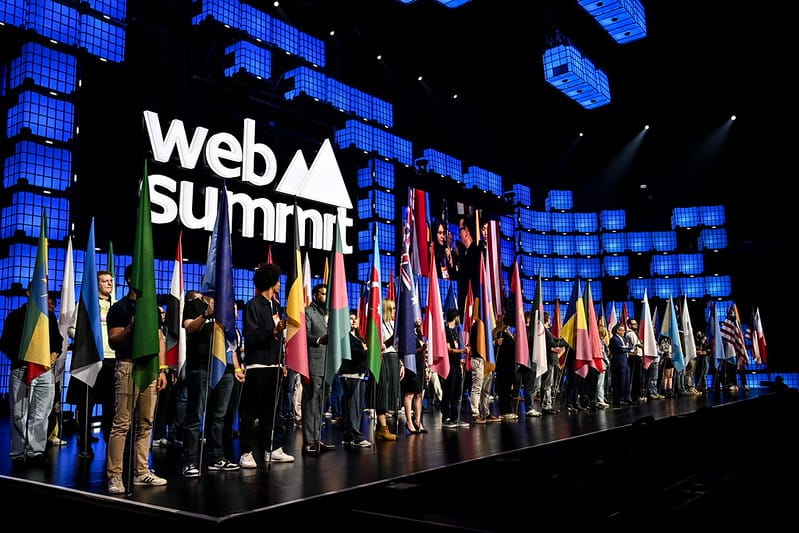
The opening session, led by Paddy Cosgrave, reflected this shift. In a speech that was less triumphalist and more geopolitical, he pointed to three recent shifts in the innovation landscape: “AI is China, payments are Brazil, startups are Poland.” It was a reminder that technological leadership is becoming more multipolar, with influence now spread across regions that traditionally played very different roles in the global tech ecosystem.
This redistribution of influence was also visible in the audience. The presence of 268 government delegations, made clear that technology is no longer a domain reserved for startups and big tech. It has become public policy, diplomacy, critical infrastructure, and an economic instrument that redefines who leads and who follows. In this context, trust is no longer an abstract value but a strategic prerequisite.
The theme of trust also surfaced in discussions about the media. Speakers from major international outlets reflected on how technological shifts, especially generative AI and the dominance of social platforms, have changed the way audiences consume and interpret information. In an environment where anyone can create and publish content instantly, professional journalism faces the challenge of re-establishing its credibility and relevance. What emerged at Web Summit was a shared understanding that the media remains society’s primary source of reliable, verified information and that preserving this role requires rebuilding trust with audiences who now navigate an informational landscape defined by speed, volume, and uncertainty.
In the creator economy, the debate took on a different tone. On opening night, striking numbers emerged: the creator economy is approaching half a trillion dollars, and 88% of high-performing creators now earn over US$100,000 a year. But Khaby Lame, the world’s biggest TikTok creator, argued that authenticity remains the human differentiator in a world flooded with automated content. His simple, direct message captured the mood of the year: audiences trust less in perfection and more in what feels real.
If the press is working to preserve trust, and creators are trying not to lose it, the AI industry is trying to build it. At Web Summit 2025, this became clear in the discussions around the rise of agents: systems capable of understanding context, intention, and preferences, which will soon replace much of the logic of traditional apps. The prevailing view was that both companies and individuals will have “teams of agents” working alongside humans – automating tasks, anticipating needs, and coordinating processes continuously.
In this scenario, Qualcomm’s CEO, Cristiano Amon, argued that the next strategic battleground for AI will not be only in the models, but in the chips. With more powerful processing directly on the device, agents will work faster, more privately, and more seamlessly in everyday life, reducing dependence on the cloud.
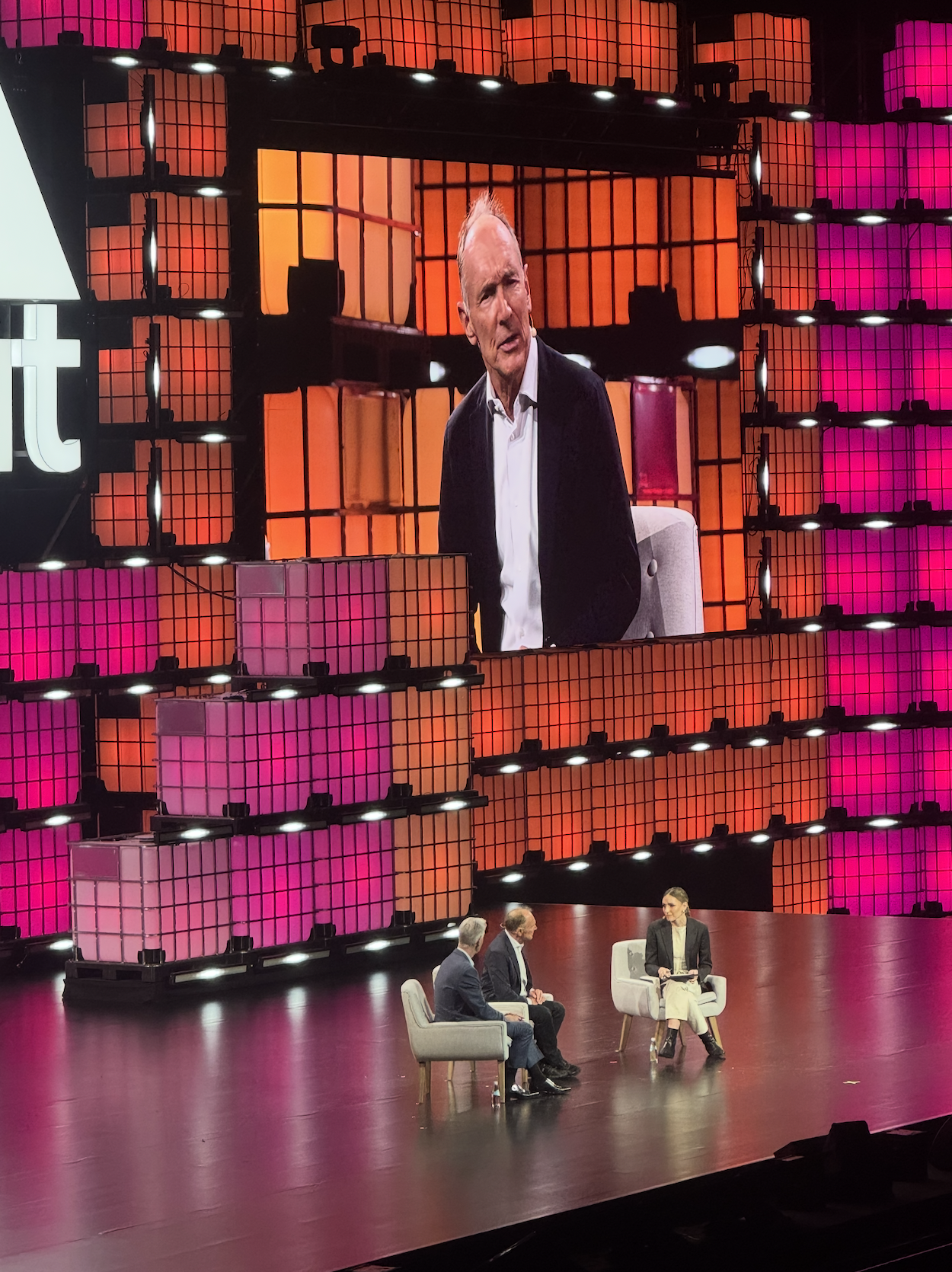
The counterpoint came from Tim Berners-Lee, creator of the World Wide Web, who reminded the audience that none of these innovations will truly be transformative unless users retain control over their data. Without interoperability and autonomy, he warned, agents could replicate, at an even larger scale, the flaws of today’s platforms. His remarks served as an essential reminder that behind every technical advance lies a deeper question of governance and individual freedom.
Even sports emerged as a testing ground for this new cycle. In a conversation with IBM, Maria Sharapova highlighted how AI is transforming athlete preparation, match analysis, and even career longevity. Here again, trust was the throughline: trusting models, data, and systems capable of interpreting what human analysis would take hours to process.
By the end of the three days, Web Summit 2025 felt less concerned with predicting the next unicorn and more focused on understanding which relationships of trust need to be rebuilt and who will have the legitimacy to rebuild them. The growth of Polish startups, the strengthening of African ecosystems, Brazil’s leadership in payments, and Asia’s acceleration in AI all underscored that the future no longer has a single center. It is distributed and distributed futures require distributed trust.
If 2023 was the year of AI euphoria and 2024 the year of regulation, 2025 emerges as the year of clarity. Technology now recognizes that it must regain public trust — and that without it, no innovation can sustain itself. Web Summit delivered a quieter, more definitive message: the important question is no longer what AI, media, or digital systems can do, but what we want to build with them. And perhaps, after so much speed, that is the most important conversation to have now.